
Corrections Reform: The Work We’ve Done and the Work Ahead
Over the coming months, as we head toward the general election, I plan to use a series of videos to talk in greater detail about my legislative record, the issues that have shaped my work in Montpelier, and the work I hope to continue if I am fortunate enough to be reelected.
I’m beginning with corrections reform.
For the past four years, I have served on the House Committee on Corrections and Institutions, and during my second term I was appointed Ranking Member. It is an area of policy where I have developed strong relationships with my colleagues and where I have been fortunate to turn several priorities into legislation that became law.
Those reforms include eliminating supervision fees for Vermonters on probation, parole, and furlough; expanding the Kids Apart program to better support relationships between incarcerated fathers and their children; and strengthening protections governing the searches and housing of transgender Vermonters in our correctional facilities. I’ve also pushed the Department of Corrections to examine the cost of providing phone calls at no cost to incarcerated people and their families.
I’m proud of that record. I’m also increasingly concerned about where some of the larger trends within our correctional system are taking us.
A correctional population moving in the wrong direction
Recent data presented by the Vermont Department of Corrections to the Joint Legislative Justice Oversight Committee illustrates the challenge particularly well.
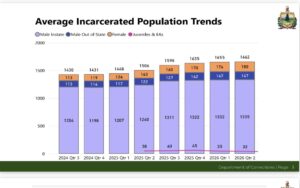
Vermont’s average incarcerated population increased from 1,430 people in the third quarter of 2024 to 1,662 in the second quarter of 2026.
That growth matters for reasons beyond the number itself. Hundreds of the Vermonters currently incarcerated have not been sentenced. Court backlogs can leave people detained for months while their cases remain unresolved. In committee, I have heard testimony about people spending so long detained that the time they have already spent incarcerated can meet or exceed the minimum sentence they ultimately receive.
Due process and the constitutional right to a speedy trial have to remain central to this conversation.
The numbers are particularly striking when we look at Vermont’s incarcerated women.
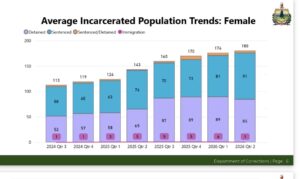
In the second quarter of 2026, Vermont incarcerated an average of 180 women. DOC classified 85 of them as detained rather than sentenced. That is nearly half of the entire female incarcerated population.
As Vermont moves forward with plans for a new women’s correctional facility, I believe we need to ask two questions simultaneously: What kind of facility should we build, and what policies are driving the number of people we believe we need to incarcerate there?
For nonviolent offenses especially, we need greater investment in restorative and community-based approaches to accountability and harm repair.
Capacity affects everyone inside our facilities
The consequences of a growing incarcerated population are visible in DOC’s own capacity data.

In this DOC presentation, green indicates facilities operating near capacity. Red indicates facilities already operating over capacity.
These buildings are also workplaces.
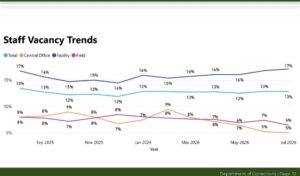
DOC reports a 17 percent vacancy rate among facility staff. When we discuss correctional infrastructure, we are discussing the daily working environment of some of Vermont’s hardest-working and most undervalued state employees.
As we design a new women’s facility and eventually modernize other correctional facilities, we have an opportunity to create more humane environments for incarcerated Vermonters and safer, better workplaces for the people we ask to staff them.
Modernization should also include the infrastructure necessary for successful reentry. Reliable Wi-Fi can strengthen our partnership with the Community College of Vermont and expand meaningful access to education and degree programs while people are incarcerated.
We also need to confront exploitation within our own system
Some of the reforms I have pursued begin with a fairly simple question: Are our own policies making successful reentry harder?
Supervision fees were one example. Vermont was charging people on probation, parole, and furlough while simultaneously expecting them to secure housing, find employment, support their families, and successfully rebuild their lives. I introduced legislation to end those fees, and that legislation became law.
Incarcerated labor demands the same scrutiny.
Incarcerated Vermonters perform work that benefits the State of Vermont while earning, on average, approximately 45 cents per hour.
I believe Vermonters should sit with that number.
I welcome efforts to provide financial literacy education inside our correctional facilities. But financial literacy needs to be accompanied by meaningful compensation. Fairer wages could allow incarcerated Vermonters to contribute to their families, pay restitution to people harmed by their crimes, and accumulate some resources for the difficult transition back into the community.
If rehabilitation and successful reentry are genuinely our goals, our policies should reflect them.
Ending Vermont’s reliance on for-profit incarceration
Vermont also continues to incarcerate roughly 150 men at a CoreCivic facility in Mississippi.
These are Vermonters living more than a thousand miles from their families, communities, and circles of support while Vermont taxpayer dollars flow to a private prison corporation that is also deeply involved in for-profit immigration detention.
I have consistently opposed Vermont’s reliance on this model.
Bringing these Vermonters home will require more than finding beds for them inside Vermont. It requires addressing why we need those out-of-state beds at all.
That means reducing unnecessary incarceration, addressing court backlogs, expanding restorative and community-based alternatives, strengthening family connections, investing in education, and creating better pathways toward successful reentry.
Four years on Corrections and Institutions have given me a much deeper understanding of both how difficult this work is and how meaningful reform can happen. I’ve built relationships that allow me to move legislation, and I’ve seen several reforms I introduced become law.
There is much more I want to finish.
If this approach to corrections reform aligns with your values and you would like to help me return to Montpelier to continue this work, I would be grateful for your support.
I am running for reelection as an Independent in a contested race and accept campaign contributions from individuals rather than corporations, lobbyists, or PACs.