
PUBLIC SAFETY: WHAT HAPPENS AFTER THE ARREST?
Calls for greater enforcement in Burlington are understandable. But any serious public-safety strategy also has to account for what happens next with regard to our courts, correctional capacity, treatment, supervision, staffing, and cost.
Public safety is perhaps the number one concern I hear about most often in Burlington, and the frustration behind those concerns is real.
People see public drug use, discarded needles, property crime, unpredictable behavior, and people experiencing profound illness and instability in public spaces. There is an understandable desire for greater intervention. We are also hearing more and more of a growing concern that an approach built primarily around tolerance and compassion, without meaningful intervention or accountability, may ultimately fail both the community and the people we are trying to help.
I understand that concern.
At the same time, four years on the House Committee on Corrections and Institutions have made me wary of public-safety conversations that end with the arrest. If Vermont moves toward greater enforcement, we need to be equally serious about the systems that receive people afterward.
Where does someone go after an arrest? What happens there? What does it cost? And are we at all engaging in any commitment to make it less likely that the same person will return to the same circumstances?
THREE SYSTEMS UNDER PRESSURE
Former Vermont Commissioner of Corrections Nicholas Deml often described the consequences of inadequate systems of care as ultimately appearing in one of three places: emergency rooms, prisons, or the streets.
That framework has stayed with me. Right now, we’re getting a front-row view of what happens when all three are reaching their individual saturation points at roughly the same time.
The street crisis is simply the one we see most easily. Moving someone from the street into the criminal legal system can change what is immediately visible, but it does not necessarily resolve the underlying problem.
A CORRECTIONAL SYSTEM ALREADY UNDER STRAIN
In February, Commissioner of Corrections Jon Murad appeared before our committee and discussed the population at Chittenden Regional Correctional Facility, Vermont’s only prison for women.
With the population again above 180 women, Murad described the situation as “absolutely shocking and untenable.” He warned that remaining at that level for an extended period could force the Department to consider reducing or moving part of the female population.
The concern did not disappear when the Legislature adjourned. When Murad appeared before the Joint Legislative Justice Oversight Committee on August 5, updated Department data continued to show serious capacity pressures.
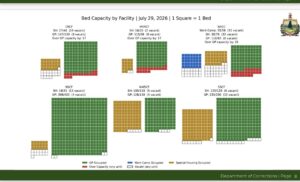
So when we talk about arresting, detaining or incarcerating more people, this is the system we’re talking about sending them into.
WHAT ARE WE BUYING FOR $114,000?
Capacity isn’t the only issue.
Vermont spends roughly $114,000 per year to incarcerate one person. Community supervision, treatment and other community-based interventions can cost dramatically less.
There are most certainly people whose conduct and level of risk make incarceration necessary. Public safety requires the capacity to hold those people safely.
But every person who can instead be safely treated, supervised, or supported in the community preserves limited correctional capacity for someone who genuinely needs it. It also gives us an opportunity to address what brought that person into the system in the first place.
The question isn’t simply whether incarceration creates an immediate consequence. We should also ask whether that $114,000 is producing the best public-safety outcome we can achieve.
CAPACITY ALSO MEANS PEOPLE
Our correctional workforce is strained too. Correctional officers and other facility staff are working in extraordinarily difficult conditions, with vacancies and substantial overtime.
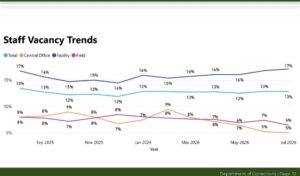
Increasing incarceration means asking that workforce to absorb more people into facilities already struggling to operate safely and humanely at current populations.
If we expect corrections to do more than warehouse people, staffing and infrastructure have to be part of the public-safety conversation.
ACCOUNTABILITY REQUIRES INFRASTRUCTURE
None of this is an argument against accountability.
People should be able to use our streets, parks and public spaces safely. People struggling with severe substance use, mental illness or instability also deserve something more effective than being allowed to deteriorate publicly until their behavior becomes sufficiently dangerous to produce an arrest.
If greater intervention is necessary, Vermont needs systems capable of carrying it out.
That means functioning courts, treatment, health care, housing, community supervision, appropriate correctional capacity, and a workforce capable of operating that system safely.
Otherwise, we haven’t solved the problem. We’ve moved people from one saturated system into another, at tremendous and often unnecessary cost.
WHAT HAPPENS AFTER THE ARREST?
I am prepared to respond if Vermont moves toward greater intervention and enforcement. I understand why people are asking for it.
But I will continue asking what happens next.
Where does the person go? What happens when they get there? What does it cost? And are we actually making it less likely that they’ll return to the same circumstances?
Those aren’t reasons to avoid action. They’re questions we need to answer if we want the action to work.
For the past four years, voters in my district have given me the opportunity to be in the room asking those questions. I’m asking for the opportunity to continue that work. If you value having an independent voice doing it, I would be grateful for your support.